
Searching Raleigh County Civil Dockets
For Circuit civil cases, go through WVPASS, West Virginia's public record system for Circuit Court. Magistrate civil and small claims run through the Magistrate Case Record Search. MCRS takes a case number or a first and last name. It uses a CAPTCHA and caps results at 30. The exact case number works best. When you search by name, confirm Raleigh County. Check the right parties, the filing date, and the court before trusting a match.
Screen time is not the whole story. The Circuit Clerk keeps Circuit and Family records, and the Magistrate Clerk keeps Magistrate civil records. Both offices sit at counters on 222 Main Street in Beckley. Circuit requests can also go by mail to P.O. Box 2518, Beckley, WV 25802. Call the Circuit Clerk at 304-255-9135 or the Magistrate Clerk at 304-255-9197 to route a request and learn current copy fees and delivery terms.
- Choose Circuit, Magistrate, or Family Court from the claim and notice.
- Search by the complete case number when it is known.
- Confirm Raleigh County, parties, code, and filing date.
- Read service, motion, hearing, and judgment entries in order.
- Request a named public paper from the correct clerk.
Raleigh Civil Docket Court Levels
Money and dispute type decide the court. Magistrate Court covers civil claims up to $20,000. It also takes small claims and unlawful entry and detainer or wrongful occupation cases where title is not in dispute. Circuit Court handles the bigger civil cases, plus equity, guardianships, administrative appeals, Magistrate appeals, and other categories set by statute. Family Court handles divorce, custody, support, visitation, and related domestic matters under its own access rule.
| Court | Typical civil docket | Public route |
|---|---|---|
| Magistrate | Small claims, limited civil claims, possession matters | MCRS, clerk counter, phone, copy request |
| Circuit | General civil, equity, appeals, guardianship | WVPASS and Circuit Clerk |
| Family | Domestic-relations orders and indices | Circuit Clerk subject to confidentiality |
Do not confuse the clerk of the court with the County Clerk at 215 Main Street. That office records deeds, liens, wills, and other county instruments. A court judgment stays in the court file. A judgment lien can also be recorded with the County Clerk as an instrument, though. Know which record you need before you ask.
Inside a Raleigh County Civil Docket
West Virginia Rule of Civil Procedure 79 requires a chronological civil docket. It lists each action and the consecutive file numbers. Documents, process issued or returned, appearances, orders, verdicts, and judgments all appear as well. Think of the docket as the event index of the Raleigh County case. It is not a full set of pleadings, exhibits, proof, or transcripts.
| Case number | Year, civil type code, sequence, and optional judge suffix, such as 19-C-140. |
|---|---|
| Parties | Plaintiff or petitioner and defendant or respondent, subject to privacy limits. |
| Service | Summons, certified mail, completed service, failed attempt, or return. |
| Activity | Complaint, answer, motion, notice, hearing, payment, and order entries. |
| Result | Dismissal, final judgment, payment, post-judgment motion, or appeal. |
A Magistrate civil docket can carry real detail. The record may list the amount in dispute, costs, interest where it applies, judgment-for and judgment-against fields, where an event took place, the judge, and why an event closed. Read the final entries with care: a case marked found is not the same as a judgment entered.
Raleigh Civil Docket Service Codes
Service entries tell you whether formal papers went out or got delivered. They can shape later settings and rulings. An MCRS record uses MCSCM for certified-mail service, MMFSI for summons issued, MGSAU for an unsuccessful attempt, and MGSSC for successful service. The labels are only clues. The return itself may hold facts the docket line leaves out.
- Service
- Formal delivery of process or notice to a party.
- Summons
- A formal notice directing a response or appearance.
- Continuance
- A postponement that should produce a later setting or order.
- Final judgment
- The court’s resolution, subject to later motions or appeal.
A failed service event is not a loss on the claim. A hearing marked closed does not by itself establish judgment. When the exact result matters, ask the clerk for the public return, order, or judgment.
Civil Case Types on the Docket
Civil dockets in Raleigh County cover several case types. On the Circuit side, code C means general civil, though the code alone will not tell you whether the fight is over a contract, property, an injury, or something else. Other codes appear too. Look for G for guardianship or conservatorship, AA for an administrative agency appeal, C-AP for a civil appeal from Magistrate Court, and S-AP for a personal-safety appeal.
- General civil actions within Circuit jurisdiction
- Magistrate civil and small-claims matters
- Unlawful entry and detainer or wrongful occupation cases
- Guardianship and conservatorship proceedings
- Administrative, Magistrate, and personal-safety appeals
- Public Family Court orders and indices
A broad code never reveals the subject of the dispute. The public caption, complaint description, docket text, and order give better context. Guardianship and personal-safety matters may also carry added access restrictions.
Raleigh Civil Docket Rule 79
The official Rules of Civil Procedure set out Rule 79, the rule that defines the chronological clerk record behind a Raleigh County civil docket.
That rule explains why the docket lists process, returns, appearances, orders, verdicts, and judgments in sequence. It also helps with copies. When the event list points to a public paper that is not online, you can request that item by name.
Civil Docket Settings and Hearings
MCRS lists Magistrate settings in a case event schedule. A record may state the event type. It can also list the date, time, room or location, judge, and the reason it closed. Raleigh County posts no single public calendar. None pulls together Circuit, Family, Magistrate, and municipal settings. For Circuit matters, WVPASS may show indexed events. Compare any online setting against the notice or scheduling order.
A motion filing is not a ruling. A notice sets a hearing, but a later continuance can push it aside. A closed event can simply mean the hearing ended while the case lives on. Check the newest entry. Call the clerk before you travel if the date or room looks shaky. For the full local date workflow, see Raleigh County court dates.
Note: A court term date is not an individual hearing date. Rely on the case event, the notice, or clerk confirmation.
Raleigh Civil Docket Filing System
Attorneys, court staff, and approved government filers work inside West Virginia Circuit and Family Courts E-File. It is the CourtPLUS-based system for submitting filings. It is not WVPASS. The two serve different crowds. For filing history, the system offers filters. They cover full case number, reference code, county, filing type, status, and date range. A result line can carry a reference code and filing type. It also lists case number, amount, filing date, processed date, and status. The Circuit and Family Court E-File overview lays out that authorized workflow.
Keep the two systems straight. A filer's receipt or clerk-review status describes a submission being processed, while a docket entry shows what actually entered the court record. Members of the public belong in WVPASS or at the clerk's counter.
Raleigh Civil Docket E-File Login
The official e-file sign-on is an authenticated filing application, not a Raleigh County civil docket search for the general public.
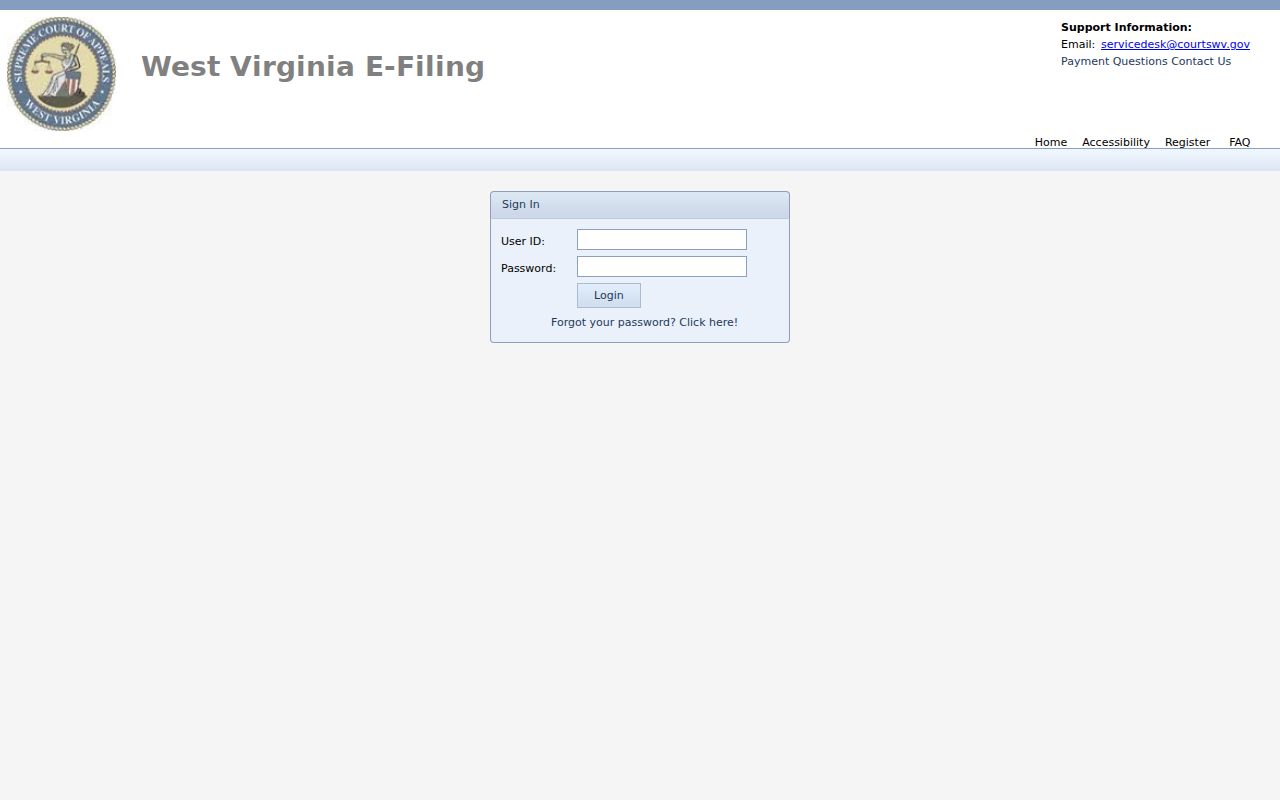
Do not mistake that login screen for a missing public portal. It was never built for browsing. WVPASS handles the Circuit search layer. Brianne Steele's Circuit Clerk office provides public copies, certified-copy guidance, and records that are not imaged online. The CourtOne transition has been announced. But that alone is no proof every planned tool is live.
Raleigh Family Civil Docket Limits
Family Court access works differently from ordinary civil access. Orders and indices are generally public. The pleadings, exhibits, recordings, transcripts, and other underlying domestic-relations papers are confidential. So name a public order or index in your request rather than asking for a whole divorce or custody file. Authorized parties hold rights the general public does not. The official Family Court rules draw these distinctions in full.
A visible case index does not make every attached Family Court paper public. The underlying documents stay confidential. Written audio requests follow a special process, and yours should identify the case style and date.
Civil Docket Access Rules
West Virginia Code §51-4-2 begins from openness. Court papers may be inspected and copied unless another law says otherwise. Trial Court Rule 10.03 adds a lever for judges. Under it, a judge can limit access to a civil file by order. The order must state the nature, duration, and reason for the limit. Guardianship, protected-person, sealed, and Family Court materials may call for a narrower request. They may also not be released at all.
Public does not mean complete. WVPASS document coverage varies, MCRS does not generally post case documents, and a public case number does not open every exhibit or protected filing.
You can request records several ways. Options include online. The proper clerk's counter, a phone call for instructions, and mail or written request also work. West Virginia's Freedom of Information Act backs inspection and copying. That includes electronic formats where reasonable, though court rules and confidentiality laws still control release. Give the clerk the case number, court, filing date, exact public record, copy type, and preferred delivery. Ask for a fee estimate first.